


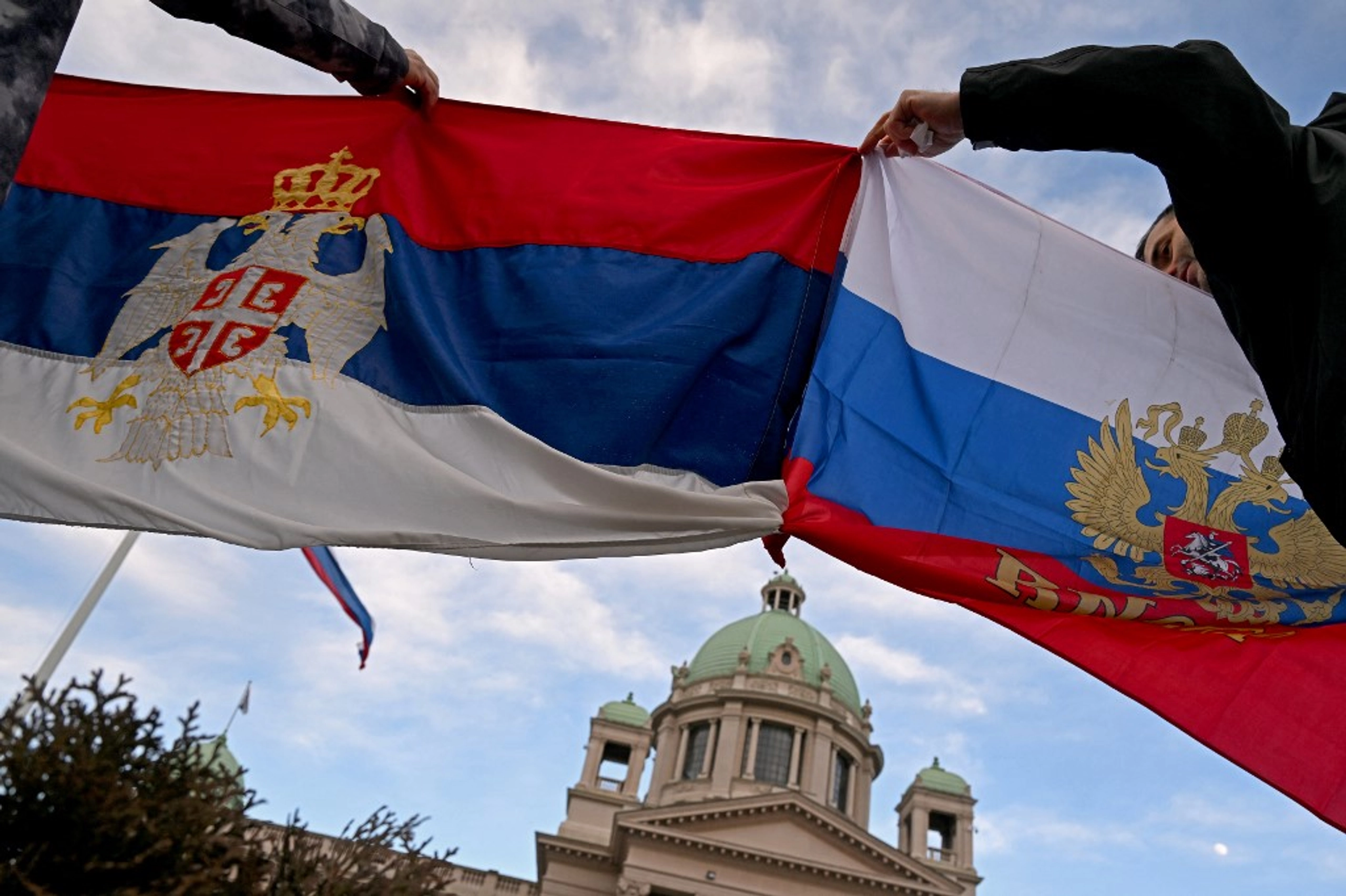
In December 2025, the team of the Center for Security Studies “CENSS”, in cooperation with the Kosovar Center for Security Studies, completed a study on the influence of the Russian Federation and other external actors on Ukraine and the countries of the Western Balkans. The study was conducted as part of the project “Strengthening Resilience to Russian Hybrid Threats through Regional Cooperation” with the support of Open Society Foundations Western Balkans and Konrad-Adenauer-Stiftung Kosovo. We continue to publish individual sections of the analytical report. This publication explores the issue of understanding the enemy’s strategic goals as a basis for analyzing the tools and methods used to achieve them.
One of the key goals of Russia’s strategy – as for demonstrating its power – is to transform a targeted state into an asymmetric federation or confederation and, by doing so, create a weak and politically dependent state. Such a state formally saves its name, has a federal government, and other formal attributes of an independent state, but is simultaneously under the enormous influence or even effective control of another state. A political entity embedded within a nation-state has the power to block and significantly influence national-level decisions, even if it is less populous or developed than the rest of the country. Therefore, asymmetry is a suitable term for such cases. Consequently, the Association of Serb Majority Municipalities, upon its establishment, should not function as an asymmetrical mechanism to diminish or compromise Kosovo’s independence. From this perspective, and based on the Ukrainian, Moldovan, and Bosnian and Herzegovina experiences, the statute should precisely delineate the status, legal framework, authority, responsibilities, formation process, and potential dissolution procedures in the event of power misuse.
In February 2022, the Russian Federation illegally recognized the so-called Donetsk People’s Republic (DPR) and Luhansk People’s Republic (LPR) as independent states and started a fullscale invasion in the same month to stop the non-existent and imaginary “genocide” of the population of the two surrogate entities. The Central Intelligence Agency of the USA warned Ukraine shortly before the invasion and made it public that Russia had prepared a “false flag” operation to justify its imminent attack.22 The fullscale invasion indicates a shift in Russia’s means and methods to achieve its objectives, with a greater reliance on military force. Concurrently, non-military means are still in use.
The Ukrainian experience is a valuable source of insights into how Russia, an indisputable leader in the use of measures short of war and hybrid warfare, acts.
Serbia-Russia cooperation and co-engagement
Serbia, a longtime antagonist of the sovereignty of Kosovo, has close ties with Russia. Russian intelligence agencies use Serbia as a foothold in the Western Balkans, allowing them to operate in neighboring countries and even further in Europe. Some Serbian citizens have participated in Russian military and paramilitary formations fighting on Russia’s side in the aggressive war against Ukraine and have received operational and tactical experience in conventional and unconventional warfare, including reconnaissance and sabotage, as well as using civilian drones as weapons. Serbia has aligned with Russia to oppose Western democracies, hypocritically declaring its intention to build a developed democracy. Based on open sources, it is necessary to highlight some cases that point to Serbia-Russia cooperation, its areas, and its depth. They encompass a broad range of areas, including intelligence, military industry, international politics, and domestic security.
Political alignment
The Serbian government has permanently included pro-Russian politicians in top positions. The most well-known is Aleksandar Vulin (Vulin), whose role is to maintain close ties with Russia and demonstrate them to the Russian, Serbian, and Western populations. Mr. Vulin held highranking posts in the Serbian government with a national security portfolio: Minister of Defense (2017-2020), Minister of the Interior (2020-2022), and Head of the Security Information Agency (BIA, (2022-2023). From May 2024 to April 2025, he was the Deputy Prime Minister of Serbia with some responsibility in the national security domain. His current position is closely connected with Russia as he serves as the Chairman of the Council of the Russian Historical Society in Serbia and also the Chairman of the Supervisory Board of the stateowned enterprise “Serbiagaz”23. The founder and editor-in-chief of the Russian project “Balkanist,” Oleg Bondarenko, names Vulin as one of the two main people from the Serbian side who deal with Russian-Serbian relations and address security issues.24 Some highlights of Vulin’s statements are as follows:
| Date | Event, Place, Origin of Source | Participants, Outlets | Key messages |
| December 3, 2021 | Meeting, Moscow, Russia | Nikolay Patrushev, then-Secretary of the Security Council of Russia | According to Vulin, Serbia will never become a platform for a campaign against Russia and its leadership led by President Vladimir Putin. The parties noted that “color revolutions” have become a traditional policy tool of certain centers of influential states, which under the pretext of democratization violate the sovereignty of a number of other countries. Therefore, free countries should resist this.25 |
| June 12, 2022 | Interview, Serbia | NOVOSTI (НОВОСТИ) | Throughout history, from the 19th century until today, the Serbs could not solve any key national issue without active and often very expensive participation for Russia, but somehow there were always those who tried to find a solution to the Serbian national issues in renouncing the Russians, and each time in the end they had to admit the collapse of such a policy. The defeat and subsequent disintegration of Russia, dreamed of by generations of Western statesmen and generals, will strengthen the Albanians.26 |
| August 23, 2022 | Meeting, Moscow, Russia | Nikolay Patrushev, then-Secretary of the Security Council of Russia |
The West’s strategic objective is to drive a wedge between Russian and Serbian peoples, Patrushev said. He expressed concern about the revival of neo-Nazi and neo-fascist ideas in Europe and the West’s use of them for geopolitical purposes, presenting its actions as “development of democracy.” These Western actions were discussed during an exchange on topical issues of regional and international security. Patrushev and Vulin also discussed further plans for Russia-Serbia cooperation in the security sphere.27 |
| December 12, 2023 | Meeting, Moscow, Russia | Nikolay Patrushev, then-Secretary of the Security Council of Russia |
Patrushev reiterated support for the course of commitment to cooperate and defend the interests of the Serbian and Russian peoples wherever they live, and emphasized that he appreciated the bravery of Aleksandar Vulin and the commitment to fight for the preservation of the independent and freedomloving position of the Serbian people and state.28 |
| August 14, 2024 | Meeting, Moscow, Russia | Nikolay Patrushev, Russian President’s assistant | Expressed gratitude to Patrushev for his dedicated efforts and support of the Russian Federation in opposing the Srebrenica resolution, as well as for his unwavering stance on upholding Serbia’s sovereignty and territorial integrity.29 |
| September 5, 2024 | Meeting, Moscow, Russia | Vladimir Putin, President of Russia | Serbia is not only a friend of Russia but an ally also. Serbia under President Vucic leadership never impose sanctions against Russia and will not allow any anti-Russia actions from its territory. Serbia is not and will not a part of anti-Russia hysteria.30 |
| October 9, 2024 | Interview, Russia | National Defense Journal | Russia is already helping us and its support is very important for us. We cooperate in the international arena, we are developing economic cooperation.31 |
| December 12, 2024 | Interview, China | TV Broadcaster CGTN | The West demands that we impose sanctions against Russia, stop Chinese investments and do everything that the EU and the US support. But Serbia is an independent state, we will never impose any sanctions on Russia and we will continue this policy. Russia is our ally, our friend. Not only historically, we also share a common future.32 |
| February 17, 2025 | Meeting, Moscow, Russia | Sergei Shoigu, Secretary of the Security Council of Russia | They discussed the development of bilateral security co-operation and the current situation in Serbia. The categorical rejection of outside interference in the internal affairs of sovereign States was reaffirmed. The Russian side indicated its readiness to continue to support the brotherly people of Serbia in maintaining stability.33 |
Notably, the US Department of the Treasury’s Office of Foreign Assets Control (OFAC) sanctioned Vulin in July 2023 during his tenure as the Head of the Serbian Security Information Agency with the following arguments:
- He used his public positions to support Russia, facilitating Russia’s malign activities that degraded the security and stability of the Western Balkans and providing Russia a platform to further its influence in the region.
- He was implicated in transnational organized crime, illegal narcotics operations, and misuse of public office. Vulin maintained a mutually beneficial relationship with U.S.-designated Serbian arms dealer Slobodan Tesic, helping ensure that Tesic’s illegal arms shipments could move freely across Serbia’s borders.
- Vulin’s acts advanced corruption within Serbia’s governing institutions. These acts included leveraging his authority for personal gain, including involvement in a drug trafficking ring.34
Despite being publicly blamed for serious wrongdoing, Vulin became the Vice Prime Minister of Serbia within a year, demonstrating his strong position in the governing circles.
Intelligence cooperation
Owing to its political alignment with Russia, Serbia has become a safe haven for Russian intelligence officers. At first glance, it seems absurd for a state to consciously host foreign spies. This is true if they work against a hosting state. However, if foreign intelligence officers agreeably stay to spy not against a hosting state but from its territory, it becomes understandable.
Since the invasion of Ukraine, many European states have made significant and coordinated attempts to disrupt Russian espionage networks. As of July 2022, 400 diplomats were expelled because they were believed to be intelligence officers or to have acted on their behalf under diplomatic cover.35 By doing so, European states dramatically diminished Russia’s espionage capabilities, especially its HUMINT capabilities. In contrast, Serbia did not follow the same path. Instead, it accepted several Russian spies who had been previously expelled from other countries. A former Serbian military diplomat described Serbia as “the last refuge in Europe for safe intelligence work by Russian operative agents.”36 According to the Serbian Ministry of Foreign Affairs, the Russian diplomatic presence in Serbia increased from 54 diplomats in February 2022 to 62 in March 2023, and as of January 2025, it was 64. Several Russian diplomats were reassigned to the embassy in Belgrade after facing expulsion or entry denial from other countries:
- Alexei Ivanenko, previously with the FSB’s 16th Center (specializing in cyber operations), was removed from Croatia and subsequently appointed as the first secretary at the Russian embassy in Serbia.
- Mikhail Generalov, after being expelled from Poland, took up the position of a counsellor at the Serbian embassy. He had a registered address at an SVR (Russian Foreign Intelligence Service) residential complex in Moscow, Russia.
- Dmitry Barabin, who was denied entry into the Netherlands, was reassigned as the second secretary at the Russian embassy in Belgrade.
- Petr Dolgoshein departed from his position in Finland and assumed the role of counsellor at the Russian Embassy in Belgrade.37
According to the Serbian media outlet Danas, Serbia’s Security Information Agency was eavesdropping on a seminar of Russian opposition members in Belgrade. Supposedly, then-Serbian Interior Minister Aleksandar Vulin handed over these surveillance recordings to Nikolai Patrushev, Secretary of Russia’s Security Council, during his visit to Moscow on May 14, 2020.38 Subsequent to the transfer of the recordings, Russian opposition figure Andrei Pivovarov, who was a co-organizer of the above-mentioned seminar, was apprehended by the Russian Federal Security Services (FSB) in Moscow on May 31, which could be interpreted as corroborating evidence of the BIA operation. It is worth noting that Russia’s FSB is mostly a security agency, nonetheless, having some intelligence bodies within. The Russian leadership has used the FSB as a tool to oppress political opposition in Russia. Interestingly, a former Ukrainian ambassador to Serbia stated to Voice of America in November 2023 that he had seen documents stating that 200 FSB personnel had come to Serbia after the influx of Russians as a result of the Russo-Ukrainian War.39
Earlier in this report, some events with Vulin’s political agenda were mentioned. Hence, it is worth noting two additional events regarding Serbia-Russia cooperation in the fields of foreign intelligence and domestic security. On October 16, 2024, Serbian Deputy Prime Minister Aleksandar Vulin met in Moscow with the Director of the Russian Federal Security Service, Alexander Bortnikov, and the Director of the Russian Foreign Intelligence Service, Sergey Naryshkin. During both meetings, they discussed further development and strengthening cooperation between the intelligence and security agencies of both countries.40
Evidence that Serbia has been used by Russian intelligence can be collected from some open sources regarding the attempted coup in its neighboring state, Montenegro, in 2016. The attempted coup was orchestrated by agents of the Russian military intelligence (GRU). According to testimony of Damon M. Wilson, Executive Vice President of Atlantic Council (AC), before the US Senate Armed Services Committee on July 13, 2017, and based on AC and others’ investigation, the key evidence is as follows:
Starting in 2014, Aleksandar Sindjelic, who led the paramilitary organization “Serbian Wolves,” commenced the deployment of Serbian combatants to Ukraine in support of Russia’s annexation of Crimea and participated in hybrid warfare in the Donbass region of Ukraine. While in Ukraine, Sindjelic established a collaborative relationship with Russian nationalists who facilitated his introduction to Eduard Shirokov (also known as Eduard Shishmakov) and Vladimir Popov. Open-source intelligence has corroborated that both individuals are operatives of the Russian military intelligence service, the GRU. This encounter laid the foundation for the subsequent coup attempt in Montenegro. Through the investigative efforts of the Atlantic Council’s #DigitalSherlocks, or its digital forensic open-source researchers, it has been ascertained that Shirokov previously held the position of Deputy Military Attaché at the Russian Embassy in Warsaw. He was accused of espionage, declared persona non grata, and expelled in June 2014. His registered address in Russia was a GRU-owned property. He obtained a false passport in August 2016, two months before his Balkan expedition. Popov, who had been observed in association with Gagauzian separatists in Moldova in 2014, accompanied Shirokov to host Sindjelic in Moscow in September 2015. There, they proposed a scheme to impede Montenegro’s NATO bid. Sindjelic procured funds from these Russian contacts to acquire weapons and supplies for the operation and to recruit participants. Open-source reporting provides compelling evidence that the GRU and its associates were directly involved in orchestrating this attempted coup, with the objective of installing a Moscow-friendly government and impeding Montenegro’s NATO accession. Had the coup succeeded, it would have inflicted a significant setback to the alliance and its credibility. It would also have halted NATO enlargement.4142
To recapitalize, this case demonstrates the abovementioned theses with the following points:
- Serbia is a hub and safe haven for Russian intelligence to operate in neighboring countries
- Serbian paramilitary groups have ties with like-minded groups in Russia
- Serbian mercenaries took part in a hybrid warfare orchestrated by Russians
- Serbian citizens can be involved in covert operations in neighboring countries on behalf of Russia and its interests.
Another case illustrating Russia’s intelligence capabilities is Novica Antić, the Chair of the Serbian Military Trade Union.
According to Politico, which saw a briefing from an unnamed Western intelligence agency, Antić was an “agent of influence” for the FSB as of October 2023. His role was to infiltrate EU institutions and spread pro-Kremlin narratives about the invasion of Ukraine. It is believed that he worked closely with FSB associate Vyacheslav Kalinin, who ran a veterans’ news website connected to Russian security and military agencies. An “About us” tab on the website said that Veteran News was an “information partner” of the FSB and the Russian Ministry of Defense.43 As of February 2025, references to the FSB were removed from the tab.
This case shows that Russian intelligence has exploited Serbian citizens to infiltrate not only neighboring countries but also EU institutions.
Military cooperation
Serbia and Russia have maintained extensive and profound military cooperation. However, sanctions imposed by the European Union, the United States, the United Kingdom, Canada, and other entities currently impede the transfer of armaments from Russia to Serbia. It is not excluded that Serbia and Russia still have some level of arms transfer. This is how the words of Milan Mojsilović, the Head of the General Staff of the Serbian Armed Forces, can be interpreted.44 In January 2025, he said that since armaments produced in the Russian Federation, and specifically in the former Soviet Union, are in service with many armies worldwide, they have been produced in other countries under license. He highlighted that Serbia established a sustainable and flexible system for supplying spare parts and maintaining military equipment even amid sanctions against Moscow. He insisted that the Serbian Army could perform high-level maintenance and produce and refurbish spare parts for a significant portion of this armament, which is now a crucial supply source. Such a murky explanation raises some questions: (1) Who owns the licensed manufacturers? It may be Russian oligarchs or Russian state-owned companies through a chain of shell companies; (2) Who are the suppliers of spare parts? (3) Who are the technicians engaged in licensed refurbishment? and so forth. These questions require research, intelligence collection, or even investigation. It appears more reasonable when recalling references to ties between Serbian high-ranking officials and U.S.-designated Serbian arms dealer Slobodan Tesic.
Before Russia was sanctioned so broadly, Serbia received many weapons from Russia and its ally, Belarus. According to open sources, some Russia–Serbia military-technical cooperation agreements were concluded in 2016. In 2016, Serbia purchased two Mi-17 helicopters for 25 million euros.45 The next year, it received six MiG-29 fighter jets from Russia for free, but with a bond to pay for their repair and modernization. Russia also allocated 2 million euros to train Serbian pilots and promised to gift Serbia 30 T-72S tanks and 30 BRDM-2MS vehicles.46 Serbia received four MiG-29 fighter jets from Belarus in 2018.47
Additional doubts about the real stance of Russia-Serbia weapons trafficking emerged in July 2019, when Russia delivered ten previously promised BRDM-2MS vehicles to Serbia. It remains unclear how they entered Serbia despite the sanctions imposed by the EU. Presumably, they were delivered by a Russian plane after the whole bunch of 60 tanks and vehicles had been prevented from being transferred over the Danube River by Romanian authorities due to EU sanctions.48 Media reports said that Russia flew those 10 armored vehicles to Serbia on its transport planes using Hungarian airspace.49
A range of top Serbian governmental civilian and military officials were rewarded by Russia’s Federal Service for Military Technical Cooperation in 2020. Among those rewarded were the Deputy Minister of Defense for Material Resources, Commander of the Serbian Air Force and Air Defense Forces, the Serbian military attaché in Moscow, and the Head of the Europe and America Department of the state-owned company Jugoimport-SDPR J.P.50
Serbian mercenaries’ participation in the Russo-Ukrainian War
Serbs have participated in the Russo-Ukrainian armed conflict since 2014. Their motives are complex and varied. Among other factors, the historical friendship between Serbia and Russia, their shared Orthodox Christian heritage, which provides a sense of common identity, and antiWestern sentiments manifested as anti-NATO attitudes stemming from negative experiences during the Balkan Wars and a desire for retribution are significant considerations. All these sentiments are supported by Russian propaganda efforts. Of course, for some Serbs, the desire to earn money is present, but in almost all cases, it is intertwined with other intangible motives.
One of the most famous Serbs who participated in Russia’s War against Ukraine was Bratislav Živković, who was killed in action by the Ukrainian Defense Forces this year. Prior to the RussoUkrainian armed conflict, Živković participated in a riot in northern Kosovo in 2012, when Serbs clashed with the Kosovo police and NATO’s KFOR contingent, a significant part of which was German troops.51 After the beginning of the Russo-Ukrainian armed conflict (2014), he gave a series of interviews to Russian media to support Russia’s recruitment efforts toward the Serbs. Concurrently, Zivkovic, a co-founder of the ultra-right paramilitary organization “Unité Continentale” in Belgrade, organized a process of recruiting and transferring Serbian mercenaries to take part in the hostilities starting from the occupation of the Crimean Peninsula, Ukraine by Russia in 2014.
ANALYSIS OF SEVERAL INTERVIEWS WITH SERBIAN MERCENARIES REVEALS THE FOLLOWING IMPORTANT ISSUES:
- Cultural and historical factors as the thrust of shared identity Russians and Serbians. “I was born in the places where battles were fought during the Serbian-Turkish war of 1876-1878. Many Russian volunteers participated in that war, including Colonel Rayevsky,52 who became the prototype of Count Vronsky from Leo Tolstoy’s Anna Karenina. Therefore, from early childhood, I was raised in an atmosphere of gratitude towards Russia and our shared history. For us Serbs, Russia is Mother Russia.”53
- Paramilitary organizations in Russia and Serbia, Russian Cossacks and Serbian Chetniks, with some overlapping history and some similar functions, are convenient tools for both governments to use on a “plausible deniability” basis. Nowadays, the Chetniks are called many Serbian nationalist paramilitary units. The symbol of the Chetniks is a black banner with a skull and crossed bones, under which is written, “With faith in God. Freedom or death.” “Broyanits,” long beards, and black “shaykacha-hat” with a cockade in the form of a double-headed eagle are characteristic features of the Chetniks’ appearance. The welcoming gesture is a three-fingered sign that signifies the Holy Trinity. The Chetniks are Orthodox Christians, as the text of their oath makes clear.54 Russian Cossacks, in accordance with Russian legislation, are required to be registered and incorporated into legal entities with a specific status. These individuals wearspecific uniforms and adhere to a hierarchical structure reminiscent of, yet distinct from, military formations. Cossacks’ “papakhahat” looks like a “shaykacha-hat”. Federal and municipal authorities are authorized to engage Cossack organizations for various forms of service, including military and law enforcement duties.55 The historic motto of the Cossacks, For Faith, Tsar and Fatherland,” is still in use.56
- Russia and Serbia have channels to engage paramilitaries and/or intelligence officers to operate in their common interests surreptitiously in either direction, either Russia or Serbia. When Dragan and a group of fellow Serbs arrived at Belgrade’s Nikola Tesla Airport in June 2023, their documents indicated that they had been working abroad for many months for a Russian construction company. However, the truth was completely different: they were all returning to their homeland from the battlefields of Ukraine, where they fought as part of the Russian airborne assault unit “Wolf” after a short period of combat training at military training grounds near Moscow. The group was the latest evidence of a clandestine scheme providing international cover for military travel from the Balkans to the front lines of Russia’s ongoing war against Ukraine. The same individual explained that GRU, Russian military intelligence, officers led the training in the camp and Russian Special Operation Forces personnel trained them either.57
- The anti-NATO motive and grievance recalled by NATO’s action is one of the main motives for the Serbs fighting on the Russian side. Grievance is widely used by Russian propaganda in Russia and Serbia. “Serbs understand perfectly well what NATO is and who we are fighting now – the very countries that have been bombing them since 1999 and before that did everything to tear Yugoslavia apart. It was NATO countries that ripped Kosovo away from them, and for the Serbs, “SMO”58 is also a holy war because we are fighting their enemies. That is why many Serbian volunteers are coming here,” said a Russian who fought with Serbian mercenaries. “When Crimea returned to Russia, they (Serbs) started to perceive it as their own national holiday. In 2014, friends called me and said, “Brother, Crimea is back – Kosovo will be back. They call themselves Russians in the Balkans, and many of them are receiving Russian citizenship,” the same individual explained. He also admitted that he initiated the installation of a monument to Alexander Nevsky in the center of Belgrade, transported humanitarian aid to Kosovo Serbs, and implemented many joint Russian-Serbian information projects.59
Ukrainian officials assert that the Serbian government is unwilling to oppose the recruitment of Serbs and their participation in the war against Ukraine.
22 Festim Rizanaj and Alban Zeneli, Comparison of Ukraine and Kosovo in Russia’s disinformation narratives, Action for Democratic Soceity/ Hybrid.info, 2024. https://hibrid.info/wp-content/uploads/2024/11/Comparison-of-Ukraineand-Kosovo-in-Russias-disinformation-narratives.pdf
23 See: https://historyrussia.org/component/yandex_maps/object/101-predstavitelstvo-v-respublike-serbiya.html
24 Vladislav Shablovsky, Serbian Locomotive: How Vulin Became the Driving Force Behind Russia-Serbia Relations, October 2024, https://rg.ru/2024/10/18/serbskijlokomotiv-kak-vulin-stal-dvizhushchej-siloj-otnoshenijrossii-i-serbii.html
25 Regnum, Serbian Minister of Internal Affairs promised Russia eternal friendship, December 2021 https://regnum.ru/news/3440738
26 Загорка Ускоковић, VUČIĆ IS NOT A LITTLE RUSSIAN, BUT A GREAT SERB: Aleksandar Vulin on Kosovo and Metohija and Western pressure, June 2022 https://www.novosti.rs/vesti/politika/1125549/vucic-nije-mali-rus-vec-veliki-srbinaleksandar-vulin-kosovu-metohiji-pritiscima-zapada
27 RIA Novosti, Patrushev said the West’s goal is to drive a wedge between Russia and Serbia, August 2022 https://ria.ru/20220823/patrushev-1811632094.html
28 Radovan Mitrovic, Alexander Vulic visited Moscow, December 2023, https://ruserbia.com/politika/aleksandr-vulinposetil-moskvu/
29 TASS, Serbia and Russia agree to strengthen strategic partnership, August 2024, https://tass.ru/mezhdunarodnayapanorama/21605467
30 Andrei Derkach, Sergei Dogotar, Vulin: “Serbia will never be part of anti-Russian hysteria”, September 2024, https://www.golosameriki.com/a/putin-talks-with-serbian-deputy-prime-minister/7771668.html
31 Natsional’naya oborona (National Defense), Aleksandar Vulin: “Serbia will never join sanctions against Russia,” October 2024 https://oborona.ru/product/zhurnal-nacionalnaya-oborona/aleksandr-vulin-serbiya-nikogda-ne-prisoedinitsyak-sankciyam-protiv-rossii-46315.shtml
32 International Affairs Vulin: Serbia will not cease cooperation with Russia and China at the request of the West, December 2024 https://interaffairs.ru/news/show/49485?fbclid=iwy2xjawin48blehrua2flbqixmaabhfcspi2s0uowz3zpecelezmwwiq7_7ga4ktt0xztk7r-0hys9jt19ukhug_aem_hlalyknczyevdoh1vmtz0q
33 Security Council of the Russian Federation, Secretary of the Security Council of Russia S. Shoigu met with Deputy Prime Minister of Serbia A. Vulin, February 2025, http://scrf.gov.ru/news/allnews/3774/
34 U.S. Department of the Treasury, Treasury Sanctions Official Linked to Corruption in Serbia, July 2023 https://home.treasury.gov/news/press-releases/jy1606
35 The Aspen Institute, Fireplace Chat with Richard Moore, July 2022 https://www.youtube.com/
watch?v=sPe6GW8GUks
36 Radio Liberty, Spy refuge. Where do expelled Russian diplomats go, March 2023 https://www.svoboda.org/a/shpionskiy-priyut-kuda-popadayut-vyslannye-rossiyskiediplomaty/32307406.html
37 Radio Liberty, Spy refuge. Where do expelled Russian diplomats go, March 2023, https://www.svoboda.org/a/shpionskiy-priyut-kuda-popadayut-vyslannye-rossiyskiediplomaty/32307406.html
38 Danas, Vulin and Patrushev: Serbia and Russia together against armed revolutions, December 2021, https://www.danas.rs/vesti/politika/vulin-ipatrusev-srbija-i-rusija-zajedno-protiv-obojenihrevolucija/?fbclid=IwAR2Kq_LiMvdbRJsDD-C9HOs98LkMGBdMxiChxZ9ia00oA7KyDd5htij_Nxs
39 Andriy Boris, Dmytro Savchuk, Former Ambassador Levchenko on how Russia is inciting a new conflict in the Balkans. Video, November 2023 https://www.holosameryky.com/a/eksposol-levchenko-prote-yak-rosiia-pidburiuie-do-novoho-konfliktu-nabalkanakh/7373953.html
40 TASS, Serbian official thanks Russian security service for support in solving challenging issues, October 2024, https://tass.com/world/1856979
41 The Attempted Coup in Montenegro and Russian Malign Influence in Europe July 13, 2017, https://www.armed-services.senate.gov/imo/media/doc/Wilson_07-13-17.pdf?form=MG0AV3
42 Christo Grozev, Balkan Gambit: Part 2. The Montenegro Zugzwang, March 2017, https://www.bellingcat.com/news/uk-and-europe/2017/03/25/balkangambit-part-2-montenegro-zugzwang/
43 Politico, Russia using Serbian agent to infiltrate EU bodies, Western intel says, March 2024, https://www.politico.eu/article/russia-use-serbia-agent-spy-infiltrateeu-institutions-western-intelligence/
44 WE ARE CAPABLE OF PROTECTING SERBS IN KOSOVO: Interview – Milan Mojsilović, Chief of the General Staff of the Serbian Army, January 2025, https://www.novosti.rs/vesti/politika/1445516/sposobni-smo-zastitimo-srbe-kosovuintervju-milan-mojsilovic-nacelnik-generalstaba-vojskesrbije
45 Petar Vojinovic, [PHOTO] New Mi-17 helicopters arrive in Belgrade: Costing €25 million, they will be in service from July 4, June 2016, https://tangosix.rs/2016/28/06/foto-novi-helikopteri-mi-17-stigli-u-beograd-placeni-25-miliona-evra-u-upotrebi-od-4-jula/
46 Delovoy Peterburg, Russia gave Serbia MiG-29 fighter jets and €2 million for pilot training, February 2018 https://www.dp.ru/a/2018/02/24/Rossija_podarila_Serbii_is
47 TASS, Serbia received four MiG-29 fighter jets from Belarus, April 2018, https://tass.ru/mezhdunarodnayapanorama/5148898
48 Associated Press, Romania says Russian military equipment for Serbia blocked, July 2019, https://apnews.com/general-newsb780669496674536b8d2e24b0bd9030e
49 Associated Press, Serbia’s leader praises Putin for boosting its military, July 2019, https://apnews.com/national-national-general-news-international-newsf16d99a1a5a74f2fbae828d5760af33a
50 RuSerbia.com, Serbian Ministry of Defense leadership receives Russian awards, September 2020, https://ruserbia.com/politika/army/rukovodstvo-ministerstvaoborony-serbii-poluchilo-rossijskie-nagrady/
51 The Geopost, Paramilitary Bratislav Živković – participant in setting up barricades in the north of Kosovo and organizer of sending Serbian mercenaries to the war front in Ukraine, February 2023, https://thegeopost.com/en/security/paramilitary-bratislav-zivkovic-participantin-setting-up-barricades-in-the-north-of-kosovo-andorganizer-of-sending-serbian-mercenaries-to-the-warfront-in-ukraine/
52 Balkan Insight, Finding Count Vronsky in Serbia, January 2018, https://balkaninsight.com/2018/01/03/finding-count-vronsky-in-serbia-01-02-2018/
53 Tatar-inform, “I fought against NATO, the West is destroying everything”: a volunteer Chetnik from Serbia on the SVO, Russia, and Ukraine, November 2023, https://www.tatar-inform.ru/news/ya-voeval-s-nato-zapadrusit-vse-dobrovolec-cetnik-iz-serbii-o-svo-rossii-iukraine-5925403
54 Stone Forest, The history of Serbian partisans, known as Chetniks, June 2024, https://stoneforest.ru/event/history/chetniki/?form=MG0AV3&form=MG0AV3
55 Decree of the Government of the Russian Federation No. 806 of October 8, 2009, “On the Procedure for Engaging Members of Cossack Societies in Public or Other Service and the Procedure for Federal Executive Bodies and/or Their Territorial Bodies to Conclude Contracts (Agreements) with Cossack Societies” (with amendments and additions) https://base.garant.ru/196407/
56 Russian Cossacks (Rossiyskoye kazachestvo), For their faith and one Fatherland: how Cossacks can believe in Allah or Buddha, March 2024, https://kazachestvo.ru/20240312/995224.html
57 Mark Krutov, Maya Zivanovich, Serbian mercenary: Russia’s war against Ukraine is built on lies and death, September 2024 https://www.radiosvoboda.org/a/rfe-rl-serbski-naymantsi-voyuyut-proty-ukrayinyrozsliduvannya/33131075.html
58 Russian acronym stands for Special Military Operations.
59 RIA News Crimea, The SVO became a holy war for Serbs – volunteer fighter, February 2025, https://crimea.ria.ru/20250220/svo-stala-dlya-serbov-svyaschennoyvoynoy–boets-dobrovolets-1144340995.html
THE FULL RESEARCH IS AVAILABLE AT
Photo source: ANDREJ ISAKOVIC / AFP