


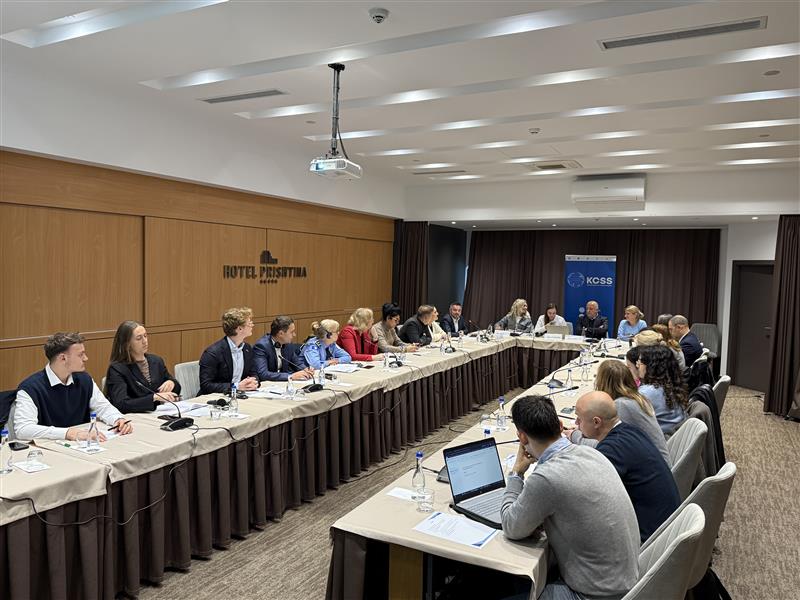
Prishtina, October 19, 2025: Experts from Kosovo and Ukraine met in Prishtina on Tuesday for a Chatham House–style roundtable on how society withstands and builds resilience to the pressures of war, displacement and malign foreign influence. The discussion was jointly by the Kosovar Centre for Security Studies (KCSS) and Ukraine’s Center for Security Studies (CENSS) within the framework of the project “Strengthening Resilience to Russian Hybrid Threats through Regional Cooperation: A Joint Initiative of Non-Governmental Organizations from Ukraine and the Western Balkans,” supported by the Open Society Foundations – Western Balkans. with the support of the Open Society Foundations Western Balkans (OSF-WB). The discussion aimed at strengthening resilience to Russian hybrid tactics, disinformation.
The discussion brought together researchers, civil society leaders and government officials to examine how community cohesion shapes security. Ukrainian speakers described how the brutal full-scale Russian invasion of Ukraine has reshaped everyday security. According to their analysis, people in Ukraine now perceive safety on three interconnected levels: individual, community and national. They noted that millions of internally displaced people, returning refugees, and more than a million veterans are reshaping local dynamics across the country.
They also warned that hybrid warfare, ranging from cyberattacks to disinformation and the use of drones has become a constant feature rather than a prelude to a conflict.
Ukraine’s experience differs from Kosovo’s in one way. While Kosovo continues to grapple with ethnic tensions that affect trust and cooperation, Ukraine’s main risks to cohesion come from displacement, political attitudes and economic pressures. Religious and ethnic divisions, speakers said, remain limited.
Kosovo participants shared how post-war recovery in a divided society required long-term investment in dialogue, youth programmes, cultural restoration and multi-ethnic cooperation. They argued that Kosovo’s two decades of experience show how local institutions, civil society and community policing can gradually rebuild trust.
Ukrainian organisations are focusing on integrating displaced families and veterans, strengthening volunteer networks, and setting up new community-level security structures. These include community police officers, emergency resilience officers and municipal working groups linking residents, police and local government.
Kosovo participants stressed that Kosovo stands firmly with Ukraine today and will continue to support it through the war and the long rebuilding process that follows. They noted that Kosovo’s own experience, from restoring local governance after war to integrating displaced communities and strengthening civil society offers practical lessons that can help Ukraine anchor its post-war state-building efforts.
Both sides highlighted that hybrid threats, especially disinformation, pose growing challenges. Ukrainian participants said that Russia now uses digital manipulation and AI-generated content to undermine unity, and even recruit for subversive acts, and youth are particularly vulnerable. Kosovo experts noted similar patterns in the Western Balkans.
The event closed with a call for deeper Kosovo–Ukraine cooperation in security, community engagement, civil society and responses to hybrid threats. Participants agreed that although the two countries face different types of challenges, they also share some of the challenges, the ambition to become members of the European Union (EU) and NATO, and an understanding that Russia poses the most serious security challenge to Europe’s security and stability.