


This English text is CENSS’s translation of the article originally written by Vadym Chernysh, Head of CENSS Governing Council, and published in Ukrainian in Journal National Interests of Ukraine, 12(17), 2025, pp. 606–621 (doi:10.52058/3041-1793-2025-12(17)-606-621).
Author
Vadym Chernysh
PhD in Law
Lecturer, Department of Theory and Practice of Management
National Technical University of Ukraine “Igor Sikorsky Kyiv Polytechnic Institute”
Kyiv, 03056, Ukraine
Head of the Governing Council, NGO “Center for Security Studies “CENSS”
ORCID: https://orcid.org/0000-0002-4904-4616
Abstract
The author of the article introduces the concept of quasi-intelligence activity of Ukrainian state executive bodies which are not intelligence or law enforcement agencies or military formations. The article not only justifies the need for quasi-intelligence activity, but also outlines its content and main features. The article also provides a comparative analysis of quasi-intelligence and intelligence activities and concludes on their differences and similarities. The article also analyzes the problems that limit the ability of Ukraine’s intelligence agencies to provide the Ukrainian government with the information necessary to formulate and implement state policy on the occupied territories.
The temporarily occupied territories of Ukraine require special attention from the state, but there is significantly less information about the situation in these territories than there is about the territories under the control of the Ukrainian state. Quasi-intelligence activities are considered a separate type of activity, and their results are seen as an important foundation for the formation of state policy regarding the occupied territories and its successful implementation. Thus, the purpose of the article is to provide a theoretical justification for the necessity of quasi-intelligence activity by the state executive bodies of Ukraine regarding the territories occupied by the Russian Federation.
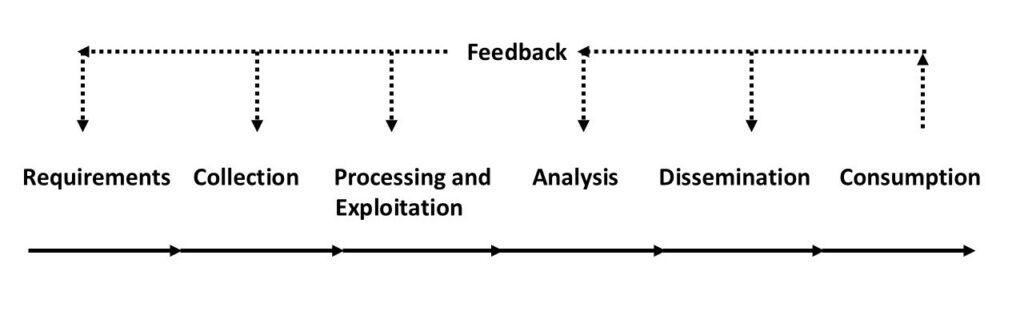
An important basis for understanding the content of both intelligence and quasi-intelligence activities is the intelligence cycle, which consists of several elements: collection, processing, analysis, and dissemination of information to consumers in the form of an analytical product.
The study analyzes examples of practical activities of the Ministry of Temporarily Occupied Territories and Internally Displaced Persons that fall under the characteristics of quasi-intelligence activity. The theoretical justification and positive experience of the practical activities of the aforementioned state executive body, analyzed in the article, form the basis for practical recommendations to the Government of Ukraine regarding the formation and implementation of state policy on temporarily occupied territories.
Keywords: intelligence activity, quasi-intelligence activity, national security, intelligence, intelligence agencies, temporarily occupied territories, state security, intelligence cycle
1. Problem Statement
A part of Ukraine’s territory remains under the control of the Russian Federation, and millions of people with Ukrainian citizenship are living under occupation. By declaring the occupation as temporary, Ukrainian authorities establish the necessity of formulating and implementing policy on the occupied territories during the occupation period. It should be understood that state policy on the occupied territories formally falls within the sphere of domestic policy, as such territories, according to Ukrainian legislation, remain within Ukraine’s internationally recognized borders.
State policy on the occupied territories is multifaceted, closely interwoven not only with national security policy, but also with other policies, such as social, educational, cultural, language, information, and others. Simultaneously, state policy on the occupied territories is closely linked with foreign policy, as the Ukrainian state relies substantially on external actors regarding the return of occupied territories.
Maintaining connections between society divided by occupation, and between the state and its citizens living under occupation, constitutes an important task for authorized state bodies. Ukraine must also exercise influence over the population in occupied territories by forming and maintaining positive attitudes toward itself and critical attitudes toward the occupying state, the Russian Federation. Both passive and active resistance by the population of occupied territories depends not only on the skill of the intelligence agencies but also on the effectiveness of the state’s influence on its citizens living under occupation.
Beyond any doubt, information about occupation conditions, activities of occupation authorities, public sentiment, conditions in various life spheres, and activities of international actors in occupied territories are important for the activities of ordinary state executive bodies[1]. However, the absence of access by state executive bodies to occupied territories, Russia’s blocking of access to the segment of its cyberspace that extends to the occupied Ukrainian territories, general restrictions on information circulation in occupied territories, and a strict counterintelligence regime significantly complicate the process of obtaining information necessary for the state. Under such conditions, theoretically, reliance could be placed on Ukraine’s intelligence agencies. However, collecting information necessary for state executive bodies’ activity on occupied territories may distract intelligence agencies from other tasks and cause complications related to the need to disperse material, financial, and other resources.
2. Analysis of Recent Research and Publications
The essence of intelligence activity and the purpose of intelligence agencies have been studied by Mark Lowenthal, Robert Clark, Michael Althoff, Michael Warner, Peter Gill, and Mark Fitian.
In this article, the author introduces the concept of quasi-intelligence activity of state executive bodies (QIA). Quasi-intelligence activity is understood as lawful activity of ordinary state executive bodies that, in some respects resembles intelligence activity, and consists of collecting and analyzing information originating from outside state territory or from territory not controlled by its government, for forming and implementing state policy in various spheres.
The article aims to provide theoretical justification for the necessity of quasi-intelligence activity by Ukrainian state executive bodies regarding territories occupied by the Russian Federation and to provide recommendations for conducting such activity.
Research methods used in this article include qualitative analysis, including comparative analysis, study of practical activities of executive bodies (case study), and certain elements of lexical and semantic analysis of texts.
3. Main Content
3.1 General Legal Basis of Intelligence Agencies’ Activities and Restrictions on Their Interaction with State Executive Bodies
The Constitution of Ukraine does not directly mention intelligence agencies. Article 17, Part 3 establishes that “ensuring the security of the State and protecting the State borders of Ukraine shall be entrusted to respective military formations and law enforcement bodies of the State, the organisation and operational procedure of which shall be determined by law [1].” Lexical and semantic analysis of this norm permits several conclusions:
- State security is the object of provision by state bodies.
- The term “national security” is not used in Article 17 of the Constitution, although it appears 19 times in other constitutional provisions.
- Ensuring state security is entrusted to certain military formations and law enforcement bodies.
The Constitution contains no provisions allowing determination of the correlation of concepts “state security” and “national security”. However, the Law of Ukraine “On National Security” defines both concepts [2]. According to this law’s provisions, “national security” is a superordinate concept to “state security,” including it as a species. The formulation of both concepts in the law presents two theoretically possible correlation variants that can be represented by Venn diagrams.
[1] In this article, ordinary authorities refer to state executive bodies that are not intelligence agencies, law enforcement agencies, or military formations.
Figure 1: The correlation of the concepts of “national security” and “state security”
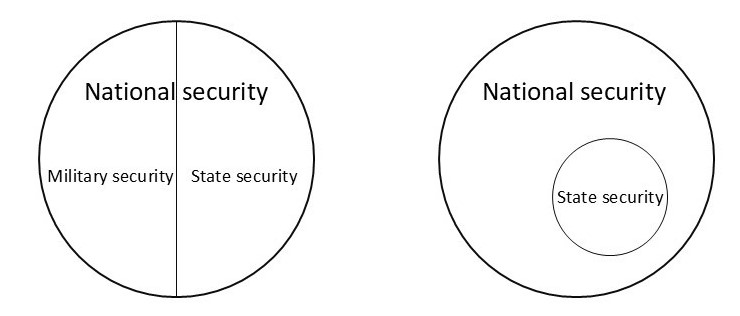
Based on the correlation of concepts defined by the above-mentioned law and the provisions of Part 3 of Article 17 of the Constitution of Ukraine, activities to ensure national security, except for ensuring state security and border protection, may be carried out by ordinary state executive bodies. This conclusion clearly indicates the need for a more thorough approach to the legal regulation of the sphere of national security and the harmonization of the provisions of the Law of Ukraine “On National Security” with the Constitution of Ukraine or, under certain conditions, the interpretation of the relevant constitutional provision by the Constitutional Court of Ukraine.
In order to determine whether ordinary state executive bodies can conduct intelligence activities, it is first necessary to answer the question of whether such activities are related to ensuring state security. State security is “the state of protection of state sovereignty, territorial integrity, democratic constitutional order, and other vital national interests from real and potential non-military threats [2]”. There are three defining features of this concept: 1) objects of protection (sovereignty and others), 2) the state in which these objects are protected from threats, and 3) the non-military nature of such threats.
The above definition is not suitable for classifying all intelligence activities as those that ensure state security. In other words, ensuring the security of such objects as state sovereignty, territorial integrity, and democratic order, as well as other vital interests, are tasks of the highest order facing the state. However, not all functions and tasks of the state reach this “peak.” Some of the information obtained by intelligence agencies is below the threshold that falls under the definition of state security (the qualification threshold for determining state security). As for ordinary state executive bodies, in order to formulate and implement policy on the occupied territories, along with information in the state security sphere, they need information that in many cases is clearly below the qualification threshold.
As already noted, the Constitution of Ukraine does not prohibit ordinary state executive bodies from conducting intelligence activities, but the relevant restriction is contained in the Law of Ukraine “On Intelligence” [3]. This law establishes a limited circle of subjects of intelligence activities, namely: the Foreign Intelligence Service of Ukraine; the intelligence agency of the Ministry of Defense of Ukraine; the intelligence agency of the central executive body that implements state policy in the field of state border protection. Thus, ordinary state executive bodies do not have the right to conduct intelligence activities to obtain intelligence information. This fully applies to information about the occupied territories of Ukraine that does not exceed the qualification threshold.
3.2 The Concept of “Intelligence Information” According to Legislation and Its Distinction from Other Information that Public Authorities May Obtain
The Law of Ukraine “On Intelligence” contains a definition of “intelligence information.” Intelligence information is verbal information, information recorded on physical media (including in samples of products and substances), or information or data stored in electronic form that is not publicly available or cannot be obtained through official channels, about the intentions, plans, and actions of foreign states, organizations, and individuals or their potential capabilities to implement such intentions and plans, as well as about processes, events, circumstances, technologies, and knowledge in the interests of Ukraine’s national security and defense [3].
In this legislative definition of the concept of “intelligence information,” two mandatory features should be noted: 1) the information collected by intelligence agencies must not be publicly available or obtainable through official channels; 2) the information must be collected in the interests of national security and defense. Thus, if the Government of Ukraine or ministries need to collect information from outside the country that is below the qualification threshold for the sphere of state security and which, in theory, can be obtained officially or, for example, purchased, they cannot rely on intelligence agencies.
The Law of Ukraine “On Intelligence” does not specify a qualification threshold above which information collected by intelligence agencies can be considered relevant to national security. Conversely, in the United States of America, there is such a threshold, the application of which is designed to distinguish “national intelligence” and “intelligence related to national security” from other information [4]. One of the important mandatory threshold criteria for this is that the intelligence information concerns more than one agency of the government of the United States of America [4].
3.3 The Intelligence Cycle as the Basis for Understanding the Process of Collecting and Using Intelligence Information
The intelligence cycle is widely known to both foreign and domestic researchers of intelligence activities. The United States Intelligence Reform and Terrorism Prevention Act of 2004 uses the term “intelligence cycle” without providing a clear definition. However, in describing the powers of the Director of National Intelligence, the provisions of this law define the components of the intelligence cycle, in particular the establishment of goals, priorities, and guiding principles for the intelligence community to ensure the timely and effective collection, processing, analysis, and dissemination of intelligence information.
Mark Lowenthal presents several meaningful visualizations of the intelligence cycle. One is presented in Figure 2:
Figure 2: One of the meaningful visualizations of the intelligence cycle
3.4 Similarities Between Intelligence and Quasi-Intelligence Activity in Information Collection
The American approach to classifying intelligence collection disciplines by source types includes five types: HUMINT (Human Intelligence), SIGINT (Signal Intelligence), GEOINT (Geospatial Intelligence), MASINT (Measurement and Signature Intelligence), and OSINT (Open-Source Intelligence). The Ukrainian intelligence community has not established foundations for officially classifying intelligence information collection disciplines. If evaluating the similarity of information collection in QIA with intelligence activity based on the Ministry for Temporarily Occupied Territories and Internally Displaced Persons of Ukraine (MTOT) experience, certain similarities can be found with HUMINT (human intelligence), GEOINT (geospatial intelligence), and OSINT (open-source intelligence).
Table 1: Comparative Table Demonstrating Similarities in Elements of Specific Information Collection Disciplines
| Intelligence Collection Discipline | Similarities in Information Collection Content during Quasi-Intelligence Activity |
| HUMINT | Selection of persons for personal contacts, preliminary study of interlocutors, knowledge of their psychological profiles, possession of communication skills with people, ability to obtain necessary information indirectly, and other characteristics. |
| GEOINT | Obtaining information from commercial entities – companies operating satellites. Such information may include satellite imagery of objects, results of earth sensing by various radars, etc. |
| OSINT | Obtaining generally accessible information appearing in printed or electronic form, including radio, television, newspapers, magazines, the Internet, commercial databases, as well as video, graphics, and images [5]. This component of activity is identical to intelligence activity. |
3.5 Analysis of Collected Information and Intelligence (Analytical) Product
Information collected through intelligence activity is subject to analysis. Analysis of obtained information creates additional value for the intelligence product; it allows filling gaps in information that cannot be obtained otherwise. The U.S. Office of the Director of National Intelligence explains the role of analysis in the intelligence cycle as follows:
Analysts examine and evaluate all the information collected, add context as needed, and integrate it into complete products. They produce finished intelligence that includes assessments of events and judgments about the implications of the information for the United States [6].
The finished product of the intelligence cycle thus represents a completed product subsequently communicated to information consumers as determined by law. The United States also has an officially approved standard for analytical work for all intelligence community analysts, which is a public document.
The methods, approaches, and principles of analyzing data collected through quasi-intelligence activity are essentially identical to those used in intelligence activity. In both cases, they aim to minimize bias, assess risks, consider alternative hypotheses, and correctly convey the probability of various events. Approaches and methods of analytical activity must necessarily account for the peculiarities of human psychology, thinking processes, and other cognitive processes, although creative elements remain important in analytical work.
3.6 Ukraine’s Experience in Authorizing State Executive Bodies to Conduct QIA
On November 28, 2018, Resolution No. 1008 of the Cabinet of Ministers of Ukraine came into force, clarifying the powers of the Ministry for Temporarily Occupied Territories and Internally Displaced Persons. The Government of Ukraine formulated the powers of the MTOT, explicitly stating its following rights:
Collect, analyze, and publish documented information about the attitudes of individuals and legal entities, international organizations, public associations, including non-governmental organizations of foreign states and international non-governmental organizations, towards individuals, events, phenomena, processes, and facts concerning the temporarily occupied territories of Ukraine and the population living there, reintegrate them into the single constitutional space of Ukraine [7].
As can be seen from the text of the mentioned resolution, it refers to the same elements that are characteristic of the intelligence cycle – collection, analysis, and disclosure (dissemination) of information. In fact, the government document refers to the quasi-intelligence activity of the MTOT. It should also be noted that some other powers of this body were essentially QIA. For example, the provision on its successor, the Ministry for the Reintegration of Temporarily Occupied Territories, stated that this body:
Collects, analyzes, and summarizes information on compliance with international humanitarian law in the temporarily occupied territory (except for the powers to coordinate the search for persons missing under special circumstances and to resolve other related issues in accordance with the Law of Ukraine “On the Legal Status of Persons Missing under Special Circumstances”), as well as in adjacent territories, and makes proposals on how to respond to violations;
Collects and systematizes information on violations of the rights of Ukrainian citizens, foreigners and stateless persons, in particular those deprived of their personal liberty as a result of the actions of armed formations of the Russian Federation, the occupation administration and/or state bodies of the Russian Federation in the temporarily occupied territory;
Monitors the activities of international humanitarian organizations on issues within its competence [8].
In addition, the MTOT was granted a number of powers regarding work and interaction with internally displaced persons (IDPs) who were forced to leave the occupied territories but retained personal (family, friends, etc.), property, and certain financial ties with citizens who remained in those territories. In 2017, the U.S. Atlantic Council in its review “Ukraine’s Internally Displaced Persons Hold a Key to Peace,” noted that many of these individuals “are building bridges between the east and west [of Ukraine][9]”. IDPs are a valuable resource for obtaining information about the functioning of all spheres of life in the occupied territories, as well as a channel for conveying information needed by the government to the population of these territories.
3.7 Illustrative Examples of MTOT’s Practical QIA (Case Study)
The Siemens Gas Turbines Case
On October 5, 2018, the press service of the MTOT published a statement titled “The occupying authorities are concealing an accident involving SIEMENS gas turbines that were brought into the territory of the Autonomous Republic of Crimea in circumvention of international sanctions” [10]. The statement referred to signs of damage to the roof of the Balaklava Thermal Power Plant (TPP) on August 30, 2018. The publication contained textual information collected prior to the accident about the delivery of turbines in violation of the sanctions regime (OSINT) and satellite images of damage to the TPP building (GEOINT). The delivery of Siemens turbines to the Russian-occupied Crimean Peninsula was known from public sources prior to the accident. In particular, in July 2017, Reuters and the British broadcaster BBC reported on this [11; 12]. The principled position repeatedly expressed by the Ukrainian Minister of Foreign Affairs in 2017-2018 was also well known, condemning the circumvention of sanctions and calling for an investigation into the delivery of turbines and the establishment of a strict regime of compliance with sanctions in the future [13; 14].
MTOT’s October 5, 2018 statement constructed an initial narrative about an accident at critical infrastructure in Russia-occupied Crimea involving smuggled Siemens turbines, with an emphasis on the German company’s violation of sanctions. This statement served as the basis for subsequent statements in Ukrainian and English by numerous media outlets and web resources, such as Ukrainska Pravda, Livyi Bereg, Interfax, KyivPost, Novynarnia, and ZAHID.NET [15; 16; 17; 18; 19; 20]. The almost simultaneous and massive dissemination of similarly-content statements amplified impact on target audiences.
The original (initial, basic) MTOT message is based on an analysis of OSINT and GEOINT information. The statement contains text narratives supported by visual information about facts in the form of high-quality satellite images. Thus, quality information collection and combination of factual information from various sources, which became “building blocks” for the original statement, determined its persuasive character.
The original statement and all other statements indicate Ukraine’s capacity to document violations of EU sanctions by its subjects. The narrative in the statement about gas turbines being brought “in circumvention of international sanctions” indicates the necessity for strengthening export control mechanisms and intensifying the sanctions regime overall. The statement addressed both Ukrainian and foreign publics as well as governments of Ukraine’s Western partners (particularly Germany and the EU).
Another narrative contained in MTOT’s original statement and preserved in most subsequent media statements based on it concerns directing attention to the incompetence and technical incapacity of Russia’s occupation administration on the Crimea Peninsula. Facts pointing to this discredit the occupation regime overall and its individual figures in the eyes of the local population.
Nearly all secondary or even tertiary statements about the accident contained references to MTOT’s original statement, allowing tracing of the information chain to its origin and verification of information source.
Sanctions Preparation Materials
Another example of QIA involves preparing MTOT materials for application of sanctions by National Security and Defense Council of Ukraine against citizens and legal entities of the occupying state. On March 19, 2019, the ministry reported that, based on information it collected, the President of Ukraine applied a series of sanctions against natural and legal persons who “created real or potential threats to Ukraine’s national interests, violated the interests of society and the state, caused property losses, and created obstacles to the full exercise by Ukrainian citizens of their proper rights and freedoms [21].” MTOT noted that it prepared materials for sanctions application – that is, collected, processed, and analyzed information about persons for whom sanctions were subsequently applied. In the sanctions lists of the aforementioned decree were found:
Individuals involved in conducting illegal archaeological search work on objects of cultural heritage;
Russian enterprises and their managers, including those conducting maritime transport and those building the Kerch Bridge;
Enterprises from European Union countries for cooperation with Russian enterprises in occupied territory;
Citizens of foreign states who, as “international observers,” participated in illegal elections of the Russian Federation President in Russia-occupied territory.
This list of subjects indicates the volume of information and types of open sources from which it should have been collected. These include printed and electronic publications distributed in Russia and its occupied territories, information about foreign citizens from their social media accounts, state databases on legal entity registration, information from official Russian electoral bodies, information from federal databases on procurement of goods and services from federal and local budgets, scientific conferences and publications in academic journals, etc.
3.8 Differences Between Intelligence and Quasi-Intelligence Activity
Despite similarities between quasi-intelligence and intelligence activity, they have essential characteristics distinguishing them from each other.
Table 2: Comparative Table Illustrating Differences Between Intelligence and Quasi-Intelligence Activity
| Aspect | Intelligence Activity | Quasi-Intelligence Activity |
| Conducted by intelligence agencies | Conducted by ordinary state executive bodies | |
| Aims to obtain information not publicly accessible or unobtainable through official channels | Aims to collect official, public, or generally accessible information (Does not exclude incidental receipt of other information) | |
| Conducted primarily in secrecy | Not conducted in secrecy | |
| Collected in the interests of national security and defense | Collected for forming and implementing state policies in various spheres | |
| Strategic task assignment conducted by the President of Ukraine through approval of the National Intelligence Program | Strategic task assignment conducted or coordinated by the Government of Ukraine |
4. Conclusions
The Government of Ukraine may create separate central executive bodies for collecting, processing, and analyzing information about occupied territories or vest such powers in existing bodies. Such activity should be conducted to comply with the intelligence cycle, including task setting, collection, processing, analysis, and consumption (dissemination) of final products for forming and implementing policies in various spheres, accounting for characteristics of temporarily occupied territories. Quasi-intelligence activity, in some respects, resembles intelligence activity but is not identical to it. Unlike intelligence activity, quasi-intelligence activity by ordinary state executive bodies cannot be conducted in secrecy.
State executive bodies authorized to collect information about conditions in temporarily occupied territories of Ukraine may collect it outside Ukraine, within state-controlled territories, and from occupied territories. Information collection methods may include:
- Personal meetings of authorized ordinary state executive body officials with Ukrainian citizens and foreign citizens who have visited, reside in, or possess information about conditions in temporarily occupied territories or information about intentions, plans, and programs of the occupying state, its partners and allies regarding temporarily occupied territories.
- Receipt of unsystematized information and information-analytical products from foreign organizations, including humanitarian and human rights organizations, etc.
- Collection of information from open sources, including monitoring of foreign online resources, social media accounts, study of scientific and expert research, etc.
- Sociological information collection methods, in particular surveys, including in cyberspace, conducting focus groups, expert interviews, in-depth interviews.
- Commercial acquisition of satellite observation data and remote sensing of the earth’s surface.
Despite the narrower spectrum of methods and techniques for information collection in QIA compared with intelligence activity, processing, analysis, and dissemination of obtained information should be organized according to approaches characteristic of intelligence agencies’ activity and described in the form of the intelligence cycle.
For quasi-intelligence activity to be effective, its principles should be established, information collection methods systematized, and analytical standards developed. It is also desirable to establish a list of analytical products that should result from such activity and be consumed by the body conducting it or other consumers for forming and implementing corresponding policies regarding occupied territories.
References
[1] Konstytutsia Ukrainy [Constitution of Ukraine]. (1996, June 28). No. 254к/96-ВР. Retrieved from https://zakon.rada.gov.ua/laws/show/254к/96-вр#Text
[2] Zakon Ukrainy “Pro natsionalnu bezpeku Ukrainy” [Law of Ukraine “On National Security of Ukraine”]. (2018, June 21). No. 2469-VIII. Retrieved from https://zakon.rada.gov.ua/laws/show/2469-19#Text
[3] Zakon Ukrainy “Pro rozvidku” [Law of Ukraine “On Intelligence”]. (2020, September 17). No. 912-IX. Retrieved from https://zakon.rada.gov.ua/laws/show/912-20#Text
[4] Intelligence Reform and Terrorism Prevention Act of 2004. Public Law 108–458. (2004, December 17). Retrieved from https://www.congress.gov/bill/108th-congress/senate-bill/2845
[5] Office of the Director of National Intelligence. (n.d.). What is Intelligence? Retrieved from https://www.dni.gov/index.php/what-we-do/what-is-intelligence
[6] Office of the Director of National Intelligence. (n.d.). How the IC Works. Retrieved from https://www.intelligence.gov/how-the-ic-works
[7] Postanova Kabinetu Ministriv Ukrainy [Resolution of the Cabinet of Ministers of Ukraine]. (2018, November 28). “Pro vnesennia zminy do punktu 6 Polozhennia pro Ministerstvo z pytan tymchasovo okupovanykh terytorii ta vnutrishno peremishchenykh osib Ukrainy” [On amending paragraph 6 of the Regulation on the Ministry for Temporarily Occupied Territories and Internally Displaced Persons of Ukraine], No. 1008. Retrieved from https://zakon.rada.gov.ua/laws/show/1008-2018-%D0%BF/ed20181128#Text
[8] Postanova Kabinetu Ministriv Ukrainy [Resolution of the Cabinet of Ministers of Ukraine]. (2016, June 8). “Deiaki pytannia Ministerstva z pytan reintehratsii tymchasovo okupovanykh terytorii” [Some issues of the Ministry for Reintegration of Temporarily Occupied Territories], No. 376. Retrieved from https://zakon.rada.gov.ua/laws/show/376-2016-%D0%BF/ed20231115#Text
[9] Van Metre, L., Steiner, S. E., & Haring, M. (2017). Ukraine’s Internally Displaced Persons Hold a Key to Peace. Atlantic Council. Retrieved from https://www.atlanticcouncil.org/in-depth-research-reports/issue-brief/ukraine-s-internally-displaced-persons-hold-a-key-to-peace/
[10] Ministry for Temporarily Occupied Territories and Internally Displaced Persons of Ukraine. (2018, October 5). Okupatsiina vlada prykhovuie avariiu z hazovymy turbinamy “SIEMENS”, shcho zavezeni na terytoriiu AR Krym v obkhid mizhnarodnykh sanktsii [Occupying authorities conceal accident involving SIEMENS gas turbines brought into the territory of the Autonomous Republic of Crimea in circumvention of international sanctions]. Retrieved from https://archive.ph/Njhyh#selection-215.0-215.125
[11] Zverev, A., Lyrchikova, A., & Stolyarov, G. (2017). Exclusive: Firm part-owned by Siemens hired to help install turbines in Crimea: sources. Reuters. Retrieved from https://www.reuters.com/article/us-ukraine-crisis-crimea-power-commissio-idUSKBN19T0VA/
[12] BBC News Ukraine. (2017). Shcho vidomo pro turbiny Siemens u Krymu? [What is known about Siemens turbines in Crimea?]. Retrieved from https://www.bbc.com/ukrainian/features-40558660
[13] Klimkin, P. (2017). Siemens-Deal: Gasturbinen illegal auf der Krim. WELT. Retrieved from https://www.welt.de/debatte/kommentare/article167198337/Siemens-Deal-Gasturbinen-illegal-auf-der-Krim.html
[14] Klimkin: Siemens zrobyv vysnovky pislia postachannia turbin do Krymu [Klimkin: Siemens has drawn conclusions after supplying turbines to Crimea]. (2018). Yevropeiska Pravda. Retrieved from https://www.eurointegration.com.ua/news/2018/02/16/7077637/
[15] Kerivnykiv Siemens sudytymut za postachannia turbin v okupovanyi Krym [Siemens executives to be tried for supplying turbines to occupied Crimea]. (2018). Ekonomichna Pravda. Retrieved from https://www.epravda.com.ua/news/2018/11/09/642504/
[16] Hazovi turbiny Siemens staly prychynoiu novoi avarii v aneksovanomu Krymu – MinTOT [Gas turbines Siemens became the cause of another accident in annexed Crimea – Ministry of TOT]. (2018). LB.ua. Retrieved from https://www.lb.ua/news/2018/11/09/412060_gazovie_turbini_siemens_stali.html
[17] UNIAN: Ukraine officials report about accident in occupied Crimea’s TPP. (2018). KyivPost. Retrieved from https://www.kyivpost.com/ukraine-politics/unian-ukraine-officials-report-about-accident-in-occupied-crimeas-tpp.html
[18] SIEMENS gas turbines cause accident at TPP in Crimea – Ministry for occupied territories, IDPs. (2018). Interfax-Ukraine. Retrieved from https://en.interfax.com.ua/news/economic/544091.html
[19] Na TES Krymu stalasia vzhe druha avariia z turbinamy Siemens, yaki ne obsluhovuie vyrobnyk [A second accident with Siemens turbines occurred at the Crimean TPP; the manufacturer does not service them]. (2018). Novynarnia. Retrieved from https://novynarnia.com/2018/11/10/na-tes-krimu-stalasya-vzhe-druga-avariya-z-turbinami-siemens-yaki-ne-obslugovuye-virobnik-mintot/
[20] Stets, A. (2018). Turbiny Siemens staly prychynoiu novoi avarii v aneksovanomu Krymu [Siemens turbines caused a new accident in annexed Crimea]. ZAXID.NET. Retrieved from https://zaxid.net/turbini_siemens_stali_prichinoyu_novoyi_avariyi_v_aneksovanomu_krimu_n1469570
[21] Ukaz Prezydenta Ukrainy (2019, March 19). No. 82/2019. “Pro rishennia Rady natsionalnoi bezpeky i oborony Ukrainy vid 19 bereznia 2019 roku ‘Pro zastosuvannia, skasuvannia ta vnesennia zmin do personalnykh spetsialnykh ekonomichnykh ta inshykh obmezhuvalnykh zakhodiv (sanktsii)’” [Decree of the President of Ukraine No. 82/2019 “On the Decision of the National Security and Defense Council of Ukraine” of March 19, 2019 “On the Application, Cancellation, and Amendment of Personal Special Economic and Other Restrictive Measures (Sanctions)”]. Retrieved from https://www.president.gov.ua/documents/822019-26290